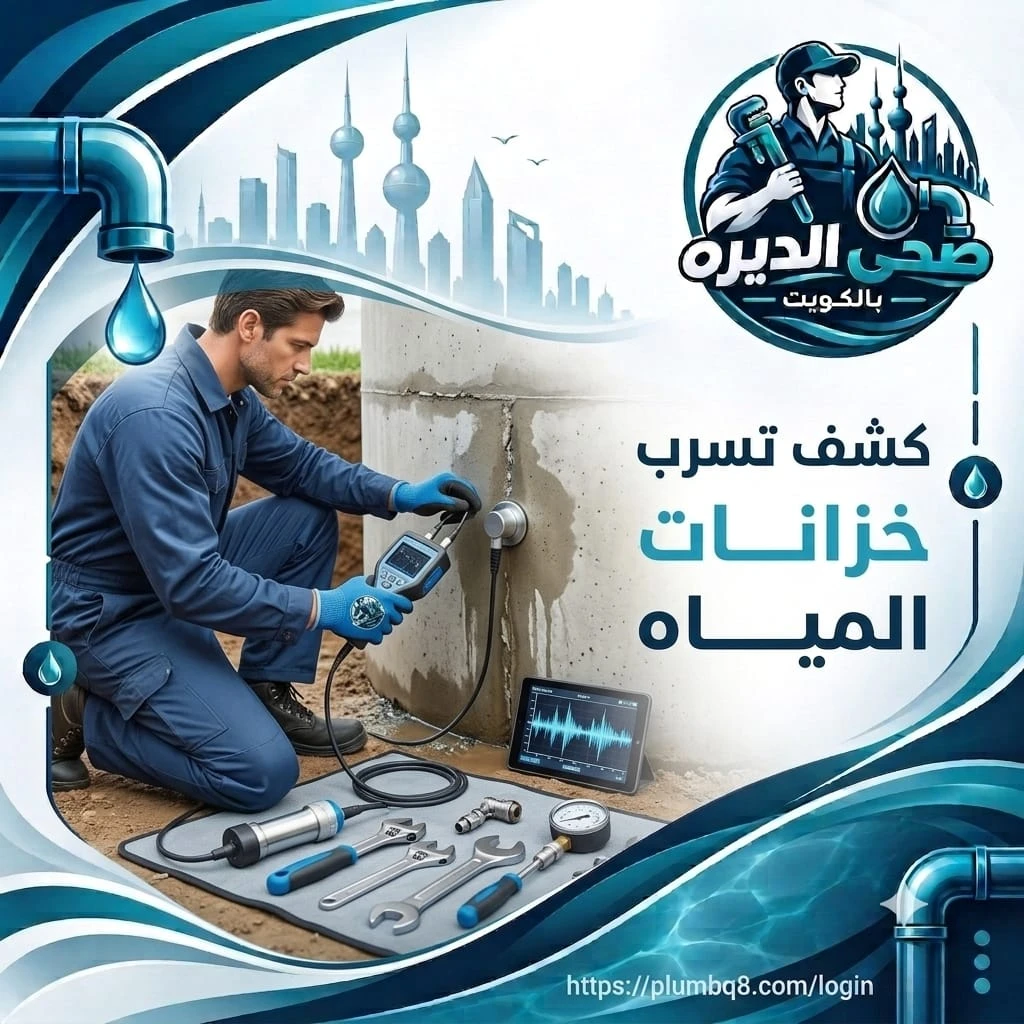
Water Tank Leak Detection in Kuwait
4 views
Checking roof and ground tanks and finding the source of water loss.
Water Tank Leak Detection
Water may leak from an underground or rooftop tank without the damaged area being clearly visible. Meanwhile, the homeowner may notice a falling water level, frequent pump operation, or dampness near the tank. The cause may be a crack in the tank body, a damaged connection, a faulty float valve, or a leak in a connected water line. A falling water level alone is therefore not enough to conclude that the tank body is damaged. The tank and its surrounding connections must be inspected, and the source of water loss must be identified before a repair method is selected.
Sehi Al Deira provides water tank leak detection services in Kuwait, including inspecting underground and rooftop tanks, checking connections and valves, identifying possible leak locations, and testing tanks when necessary. The service begins by reviewing the symptoms, tank type, and how it is connected to the water network. Visible components are then inspected, and an appropriate test is selected to isolate the source of water loss. The inspection and repair method depends on the tank material, location, and nature of the damage, while protecting the safety of the stored water and avoiding procedures that could cause further damage to the tank or its plumbing.
Water Tank Leak Detection in Kuwait
A leaking water tank may cause a continuous drop in the water level, water accumulation around its base, or dampness in walls adjacent to an underground tank. The signs may not be obvious if the leak is slow, occurs at a concealed connection, or allows water to escape into the soil surrounding the tank.
Water tank leak detection in Kuwait begins by reviewing the rate of water loss and when it occurs. The tank body, connections, valves, and inlet and outlet lines are then inspected to identify the possible source.
Sehi Al Deira provides water tank leak inspection services in Kuwait, distinguishing between water loss caused by damage to the tank body and loss associated with connections or the filling system.
Water may continue to escape through the overflow pipe because of a faulty float valve, making the problem appear to be a leak from the tank itself. Water may also be lost through a connection on the supply line or outlet line without any crack in the tank body.
In underground tanks, dampness around the tank may result from a nearby leaking pipe or water entering from an external source, rather than water escaping from inside the tank. The direction of water movement and the circumstances in which dampness appears must therefore be reviewed before the repair location is determined.
When damage to the tank body is suspected, an appropriate test is selected according to its material and installation method. Procedures that could compromise the tank's integrity or contaminate the stored water must be avoided.
Water tank leak detection services in Kuwait include:
-
Reviewing signs of water loss and dampness and identifying when they occur.
-
Inspecting the tank body, connections, valves, and inlet and outlet lines.
-
Checking the float valve and overflow pipe when water loss is suspected.
-
Determining whether an appropriate test is needed to isolate the source of the leak.
-
Explaining the possible location of damage and the suitable treatment according to the tank's type and condition.
Water Tank Leak Inspection
Water tank leak inspection helps determine whether water is being lost through the tank body or one of its connected fittings. Water droplets may appear at the tank's base even though they originate from a connection higher up and run down its exterior. The location where water accumulates may therefore differ from the actual leak point.
The service begins by reviewing the tank's external condition and inspecting accessible connections and valves. It is then determined whether the water level needs to be monitored or an appropriate test performed.
Sehi Al Deira provides water tank leak inspection services, checking the components connected to the tank before assuming that its body is damaged.
If the tank has a pump or an automatic filling system, water movement during operation may affect how a falling water level is interpreted. Usage and filling conditions must therefore be considered when assessing whether water loss is abnormal.
Signs of old dampness may also remain around the tank's base after a previous leak has been repaired. Their presence alone does not prove that the problem is ongoing. New water accumulation or a continuing change in the tank's water level should be verified.
If a leak is suspected in a concealed section, it may be necessary to inspect hidden connections or perform a test appropriate for the tank's material and location, rather than opening finished surfaces or dismantling connections without a clear indication of the source.
Water tank leak inspection services include:
-
Examining the tank body, base, and areas where pipes connect to it.
-
Reviewing the condition of valves, connections, and the overflow pipe.
-
Monitoring signs of water loss while considering usage and filling conditions.
-
Distinguishing, as far as possible, between old dampness and an ongoing leak.
-
Determining the appropriate test or repair after narrowing down the source of water loss.
Underground Water Tank Leak Detection
Underground water tank leak detection can be more complicated when the tank body is surrounded by soil or enclosed within a concrete chamber. Leaking water may travel into surrounding areas without appearing directly on the surface. The problem may instead become apparent through a falling water level, dampness on a wall of the tank chamber, or water accumulation nearby.
The service begins by reviewing the tank's condition, type, and location. Visible connections and the filling, suction, and overflow lines are then inspected before damage to the tank body is suspected.
Sehi Al Deira provides underground water tank leak inspection services, selecting an appropriate test according to the tank's characteristics and the accessibility of its components.
Dampness around an underground tank may result from water escaping from inside it, but it may also be caused by groundwater or water from nearby pipes entering the tank chamber. These sources must be distinguished because the treatment differs according to the direction and location of the leak.
In concrete tanks, water loss may be associated with a crack in the structure, damage at the junction between a wall and the floor, or deterioration around a pipe opening. Tanks made from other materials may have different potential damage locations and require different repair methods.
No one should enter an underground tank or descend into its enclosed chamber without assessing the risks and taking appropriate safety precautions. Internal inspection may require specialized equipment and procedures, and entering the tank is not necessary in every case.
Underground water tank leak detection services include:
-
Reviewing the rate of water loss and the condition of the tank chamber and surrounding area.
-
Inspecting accessible filling, suction, and overflow lines and their connections.
-
Distinguishing between water escaping from the tank and water entering from an external source.
-
Identifying possible damage locations according to the tank material and installation method.
-
Selecting an appropriate test while protecting worker safety and the cleanliness of the stored water.
Rooftop Water Tank Leak Detection
A leaking rooftop water tank may cause water to accumulate around its base or on the roof, or produce damp patches on the ceiling below. The source may be the tank body, a connection at the water inlet or outlet, or the overflow pipe if filling continues after the water reaches the required level.
Rooftop water tank leak detection begins by inspecting the visible parts of the tank, connections, and valves. The filling system, float valve, and the base supporting the tank are also reviewed.
Sehi Al Deira provides rooftop water tank leak inspection services, identifying the water source before recommending repairs to the tank body or replacement of a connection.
Water may run down the tank's exterior from a connection near the top and collect at its base. The point where water accumulates is therefore insufficient to identify the leak location. Connections are inspected from top to bottom where they can be accessed safely.
Water accumulating on the roof may also result from continuous discharge through the overflow pipe because of a faulty float valve, or from a leak in a pipe connected to the tank. In such cases, repairing the tank body would not address the problem.
Safe access to tanks installed on rooftops must be considered, particularly near roof edges or on elevated supports. A full tank should not be moved or lifted to inspect its base because the weight of the water may create risks for people and connected plumbing.
Rooftop water tank leak detection services include:
-
Inspecting the tank body, base, and visible connections.
-
Reviewing the float valve, overflow pipe, and filling system.
-
Tracing visible water to distinguish where it accumulates from where it originates.
-
Inspecting inlet and outlet lines before suspecting a crack in the tank body.
-
Determining the treatment method while considering safe access to the tank and the stability of its support.
Locating a Water Tank Leak
The location of a water tank leak may differ from where water becomes visible, particularly when droplets travel along the tank's exterior or move across its base or surrounding wall. Locating a water tank leak helps direct repairs toward the damaged component rather than treating a visible damp patch without confirming its source.
The service begins by reviewing signs around the tank and inspecting connections, valves, and pipe entry points. Components requiring additional testing are then identified.
Sehi Al Deira provides water tank leak location services, reviewing the path of visible water, tank type, and nature of the possible damage.
If water appears near a pipe opening, the cause may be a damaged connection or deterioration where the pipe joins the tank body. If water loss appears to originate from a section of the tank body away from its connections, a localized inspection may be necessary to confirm whether the material is cracked or damaged.
In underground tanks, the entire exterior surface may be difficult to access. Locating the leak may therefore depend on the available inspection points and the results of suitable tests. Damage should not be assumed to exist in a concealed section without sufficient evidence.
Confirming the source may require isolating certain connections or monitoring the water level under controlled conditions. Such procedures must be performed without allowing the pump to run without water or disabling essential systems.
Water tank leak location services include:
-
Inspecting the areas where pipes and valves connect to the tank body.
-
Tracing visible water to identify its possible source.
-
Reviewing the tank body, base, and areas suspected of being damaged.
-
Determining whether additional testing is required when the source of water loss is not visible.
-
Directing repairs toward the damaged component after the problem's location has been verified.
Water Tank Leak Detection Technician
Inspecting water tank leaks requires distinguishing damage to the tank body from problems involving connections, valves, and filling systems. A relatively minor float valve fault may allow water to discharge continuously through the overflow pipe, while a crack in the tank body may cause water loss even when the filling system is not operating.
A water tank leak detection technician begins by reviewing the tank type, location, and connection to the water network. Visible components are then inspected, and the symptoms are assessed to narrow down the possible cause.
Sehi Al Deira provides water tank leak inspection services, selecting a diagnostic method according to the tank material and the accessibility of its components.
If the leak is associated with a damaged connection, the treatment may differ from repairing a crack in the tank body. Certain types of damage or deformation may also make tank replacement an option that needs to be evaluated instead of attempting an unsuitable localized repair.
Inspection and repair work must take into account the tank's use for storing household water. Repair or waterproofing materials should not be used inside the tank unless they are suitable for contact with water intended for its particular use and are applied according to the product instructions.
For elevated tanks or enclosed underground tanks, access and working risks must be assessed before inspection begins. Procedures that could endanger people or damage the plumbing should not be performed.
Services provided by a water tank leak detection technician include:
-
Reviewing the tank type, location, and symptoms of water loss.
-
Inspecting the tank body, connections, valves, and filling system.
-
Selecting an appropriate test to confirm the leak source when necessary.
-
Assessing the nature of the damage before choosing a localized repair or replacement of the affected component.
-
Considering safe access to the tank and the suitability of repair materials for its intended use.
Water Tank Leak Testing
Water tank leak testing helps verify whether abnormal water loss is occurring and determine whether it is associated with the tank body or its connected plumbing. The appropriate test varies according to the tank material, location, and operating method, so a single procedure should not be applied to every type of tank.
The service begins by reviewing the condition of the tank, connections, and valves. Conditions that allow the water level to be monitored or the source of water loss to be isolated appropriately are then identified.
Sehi Al Deira provides water tank inspection and testing services when a leak is suspected, selecting a procedure suitable for the tank's characteristics and condition.
Monitoring changes in the water level over an appropriate period may help establish whether water is being lost. However, normal consumption, automatic filling, and discharge through the overflow must be considered to avoid misinterpreting the results.
Distinguishing between a leak in the tank body and a leak in a connected line may require inspecting or isolating connections according to the network's configuration. This must be done without allowing the pump to run dry or creating unsuitable pressure inside the tank.
A pressure test should not be performed on a tank that is not designed to withstand pressure, because ordinary storage tanks differ from pressure vessels. Tools or materials that could contaminate the stored water must also be avoided during inspection.
Water tank leak testing services include:
-
Reviewing the tank type and condition before selecting a testing method.
-
Inspecting connections, valves, and the filling system to identify possible sources of water loss.
-
Monitoring changes in the water level under conditions that allow the results to be interpreted correctly.
-
Determining whether connections need to be inspected or isolated according to the network's configuration.
-
Avoiding unsuitable pressure tests and procedures that could affect the safety of the tank or stored water.
Identifying the Cause of a Falling Water Tank Level
The water level inside a tank may fall because of a leak in its body, water loss from a connection, discharge through the overflow pipe, or higher-than-usual consumption. The drop may also be associated with a fault in the filling system or an insufficient supply of water to the tank. It is therefore necessary to distinguish between water being lost and water not being replenished during use.
The service begins by reviewing the pattern of the falling water level and when the pump or filling system operates. The tank, accessible connections, and valves are then inspected.
Sehi Al Deira provides services for investigating falling water tank levels, reviewing the filling system and consumption before assuming that the tank body is cracked.
If the level falls during water use and then fails to rise at its usual rate, the problem may be associated with the tank's water supply, pump, or inlet valve. If the level continues to fall when there is no known consumption, possible sources of water loss may need to be investigated.
A faulty float valve may allow water to continue entering the tank and escaping through the overflow, causing water loss without any crack or dampness around the tank body. A leak may also occur in the outlet line after the tank, allowing stored water to be lost even though the tank itself is undamaged.
The tank system should therefore be examined as a connected arrangement of the tank body, valves, pipes, and pump. The component responsible for the problem can then be identified before repairs begin.
Services for identifying the cause of a falling water tank level include:
-
Reviewing the rate of water loss and its relationship to consumption and filling.
-
Inspecting the float valve, overflow pipe, and inlet and outlet lines.
-
Checking the pump or supply system when insufficient filling is suspected.
-
Inspecting the tank body and connections when there are indications of water loss.
-
Identifying the possible cause of the falling level and selecting the appropriate inspection or repair.
Detecting Cracks in Water Tanks
Cracks may develop in a water tank because of localized damage to its body or at a connection point. They may be visible on the surface or concealed in an area that is difficult to access. Not every surface mark indicates a crack that allows water to escape, and the absence of a visible crack does not rule out damage in a concealed section or at a connected fitting.
Detecting cracks in water tanks begins by reviewing the tank material and overall condition. Accessible sections, pipe connection points, and the base are then inspected to identify areas suspected of being damaged.
Sehi Al Deira provides water tank crack inspection services, assessing the nature of the damage and whether it is associated with water loss before determining a treatment method.
In plastic tanks, damage may appear near a connection opening or in a section subjected to stress or deformation. Concrete tanks may develop cracks or weak areas around joints and pipe openings. The appropriate treatment differs according to the nature of the damage.
A suspected crack may require an appropriate test to confirm that water can escape through it, particularly if there are no clear signs of leakage. It is also necessary to determine whether the damage is localized or associated with a broader problem affecting the tank body or base.
Not all cracks can be treated in the same way. Damage may require replacement of a component, specialized repair, or an assessment of whether the tank should be replaced. Repair materials must be suitable for the tank material and its use for storing water.
Water tank crack detection services include:
-
Inspecting the tank body, connection points, and base for visible damage.
-
Distinguishing surface marks from cracks suspected of causing leakage.
-
Determining whether an appropriate test is needed to confirm that water escapes through the damaged area.
-
Assessing the nature of the crack and the tank's condition before selecting a treatment method.
-
Considering whether repair materials are suitable for the tank material and the type of water stored.
Home Water Tank Leak Inspection
Home water tank leak inspection helps assess the condition of the tank and its connected plumbing when water loss, dampness, or unusually frequent pump operation is noticed. The inspection considers the tank as part of the household water network because the source of water loss may be in its body or in one of its connected lines or valves.
The service begins by reviewing the tank type, location, and filling method. Visible components are then inspected, and symptoms requiring additional testing are identified.
Sehi Al Deira provides home water tank inspection services in Kuwait, covering underground and rooftop tanks and their connected plumbing.
Water may appear near the tank's base because of a leak from a connection higher up, an overflow fault, or a nearby external source. The water source must therefore be traced rather than simply treating the location where it accumulates.
A falling water level does not necessarily mean that the tank is damaged. It may be associated with unnoticed consumption, a leak in the water network downstream of the tank, or a problem with the filling system. Examining these possibilities helps identify the component that needs repair.
Once a leak has been confirmed, the treatment method is determined according to the location of the damage, tank material, and overall condition. The cleanliness of the stored water and the safety of the connections must be considered before the tank is returned to normal use.
Home water tank leak inspection services include:
-
Reviewing signs of water loss and the tank's type and location.
-
Inspecting the tank body, base, connections, valves, and connected water lines.
-
Reviewing the filling system, overflow, and possible sources of consumption.
-
Determining whether additional testing is needed to confirm the leak location.
-
Explaining the appropriate treatment after identifying the cause of the problem and assessing the tank's condition.
Frequently Asked Questions About Water Tank Leak Detection
How can I tell if my water tank is leaking?
Signs such as a falling water level without known consumption, water appearing around the tank, or dampness in the surrounding area may indicate a leak. However, these signs do not prove that the tank body is damaged. Water may be escaping from a connection, the overflow pipe, or a line connected to the tank.
Does a falling water tank level mean the tank is cracked?
Not necessarily. The drop may result from water consumption, a filling system fault, discharge through the overflow, or a leak in the connected pipe network. These possibilities should be examined before a crack in the tank body is suspected.
How is an underground water tank leak detected?
The inspection begins by reviewing the water level, the condition of the tank chamber, connections, and inlet, outlet, and overflow lines. An appropriate test may be necessary to distinguish between water escaping from the tank and water entering the surrounding area from an external source.
Can a leaking rooftop water tank be repaired without replacing it?
This depends on the leak location, tank material, nature of the damage, and overall condition. The problem may involve a connection or valve that can be repaired or replaced, while damage to the tank body may require an assessment of whether repair or replacement is appropriate.
Can a faulty float valve cause water loss?
Yes. A faulty float valve may allow the tank to continue filling after the water reaches the required level, causing water to escape through the overflow pipe. In this case, the water loss is associated with the filling system and does not necessarily indicate a crack in the tank body.
How is the location of a water tank leak determined?
Connections, valves, the tank body, and its base are inspected while the path of visible water and the circumstances of the falling water level are reviewed. Additional testing may be necessary if the source is concealed or water accumulates away from the actual leak point.
Can a water tank be pressure-tested?
A pressure test should not be performed on an ordinary storage tank that is not designed to withstand pressure. The appropriate test is selected according to the tank type, specifications, and installation method, while avoiding procedures that could damage it or contaminate the stored water.
Can cracks in a water tank be repaired with any waterproofing material?
No. The repair material must be suitable for the tank material and the nature of the damage. When applied to internal surfaces, it must also be suitable for contact with the stored water. Localized repair may not be appropriate for certain cracks or types of deformation.
Does dampness around an underground tank prove that water is leaking from it?
No. Dampness may result from a leak in the tank or nearby plumbing, or it may be associated with water entering the tank chamber from an external source. The source must be identified before a treatment method is selected.
Does the tank need to be completely emptied during leak inspection?
Not every inspection requires the tank to be emptied. This depends on the possible leak location, the type of test, and the nature of the required repair. The appropriate procedure is selected while protecting the tank, maintaining the cleanliness of the stored water, and preventing the pump from running without water.
Request Water Tank Leak Detection from Sehi Al Deira
If you notice an unusual drop in your tank's water level, water accumulating around its base, or dampness near an underground or rooftop tank, you can request Sehi Al Deira's water tank leak detection service. The tank, connections, and filling system can be inspected to identify the source of water loss before repairs begin.
Sehi Al Deira provides water tank leak detection services in Kuwait, from inspecting underground and rooftop tanks and locating leaks to checking valves and connections and testing tanks when necessary, with an explanation of the cause and an appropriate treatment method according to the tank's type and condition.